For a private company navigating India’s corporate compliance landscape, the classification of “small company” carries real weight. It is not just a label — it determines how many board meetings you hold, whether your auditor needs to rotate, whether a cash flow statement is required, and how large a penalty you face for a procedural default. As of December 1, 2025, the Ministry of Corporate Affairs has significantly raised the threshold limits under the Companies Act, 2013, pulling a much larger segment of private businesses into this category for the first time.
The change came through Notification GSR 780(E), which amended Rule 2(1)(t) of the Companies (Specification of Definition Details) Rules under Section 469 of the Companies Act, 2013. It took effect immediately upon publication and is expected to reduce the compliance burden for an estimated ten lakh companies across India.
How the Definition Has Evolved Since 2014
The concept of a small company was introduced when the Companies Act, 2013 came into force, but the original thresholds were extremely conservative. A company with paid-up capital above ₹50 lakh or turnover above ₹2 crore was already outside the bracket.
The limits have been revised three times since then:
| Effective Date | Paid-Up Capital Limit | Turnover Limit |
| 01 April 2014 | ₹50 lakh | ₹2 crore |
| 01 April 2021 | ₹2 crore | ₹20 crore |
| 15 September 2022 | ₹4 crore | ₹40 crore |
| 01 December 2025 | ₹10 crore | ₹100 crore |
Each revision has been directionally consistent — broadening the definition to bring more companies under the simplified compliance framework. The 2025 amendment is the most significant jump yet, more than doubling both figures in a single notification.
The Current Definition: What Qualifies as a Small Company
Under Section 2(85) of the Companies Act, 2013, as amended with effect from December 1, 2025, a small company is a private company — other than a public company — that satisfies both of the following conditions simultaneously:
- Paid-up share capital not exceeding ₹10 crore, and
- Turnover not exceeding ₹100 crore as per the profit and loss account for the immediately preceding financial year.
Both conditions must be met together. A company with ₹8 crore in paid-up capital but ₹120 crore in turnover does not qualify. The threshold is a dual filter, not an either/or criterion.

It is also worth noting that classification is automatic. A company that falls within these limits qualifies as a small company without filing any form or making any declaration. Equally, when a company crosses either limit, it transitions out of the small company category in the same automatic fashion — no form is required for that conversion either.
Who Cannot Be a Small Company
The definition has clear exclusions that do not change regardless of financial size:
A public company cannot be a small company under any circumstances. A holding company or subsidiary company of any other company is similarly excluded, even if its own financials fall within the thresholds. A Section 8 company — registered for charitable or not-for-profit purposes — also falls outside the definition. Only a private limited company that is neither a holding nor a subsidiary entity can be classified as small.
The Compliance Advantages That Come With the Classification
The practical value of being classified as a small company lies in what you are not required to do. Several mandatory obligations that apply to other private companies are either removed or simplified for small companies.
Board meetings are reduced from the standard four per year to just two. The two meetings must be held in different halves of the calendar year, with a gap of not less than 90 days between them. Many routine board decisions can also be passed through resolutions by circulation.
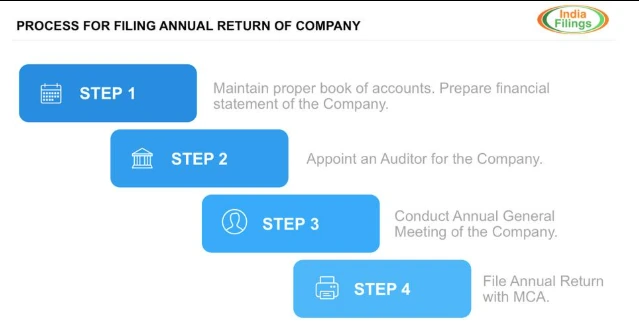
Annual return filing shifts from the detailed Form MGT-7 to the abridged Form MGT-7A, which requires fewer disclosures. Where no company secretary is appointed, a single director is permitted to sign the return.
Cash flow statements are not required as part of the financial statements of a small company. This reduces both the preparation time and the cost of annual compliance for businesses where cash flow reporting adds little analytical value.
CARO — the Companies Auditor’s Report Order — does not apply to small companies. Auditors are not required to prepare and attach a CARO report with the audit report, which meaningfully shortens the audit process and reduces professional fees. A practical note on this: a company with turnover of ₹95 crore as on 31 March 2025 — which was outside the old ₹40 crore limit and therefore not a small company for FY 2024-25 — would have been required to attach a CARO report for that year. The December 2025 amendment does not retroactively change that position.
Internal Financial Controls (IFC) reporting is not required in the audit report of a small company, and internal audit is not mandatory unless the company falls within a specifically notified class.
Auditor rotation under Section 139(2) does not apply. Small companies are not obligated to change their auditor after five or ten years of appointment. The same audit firm or individual auditor can continue indefinitely, which supports continuity and reduces the cost of onboarding a new audit firm.
E-form certification by a practising CA, CS, or advocate is not required for forms filed by small companies, reducing professional cost and turnaround time for routine filings.
Demat and ISIN provisions under Section 29 read with Rule 9B do not apply. Small companies are not required to obtain an ISIN or convert shares to demat form. Share-related transactions can continue in physical form, and there is no requirement to file Form PAS-6.
Penalties for defaults under Section 446B are capped at half the standard amount — subject to a maximum of ₹2 lakh for the company and ₹1 lakh for an officer in default. This matters in practice because it limits the financial exposure from minor procedural non-compliance, which is a real risk for companies with limited in-house compliance infrastructure.
A Practical Ambiguity Worth Watching
The December 2025 timing introduced a specific uncertainty that, as of early 2026, awaits formal MCA clarification. The amendment came into force on December 1, 2025 — the same period during which the deadline for filing FY 2024-25 annual returns was extended. Companies that newly qualify under the revised thresholds face a genuine question: should they file Form MGT-7 (the standard return, applicable to their status on March 31, 2025) or Form MGT-7A (the abridged form now available to them under the new definition)?
Similarly, the exemption from cash flow statement requirements and the prospective application of auditor rotation relief create grey areas for companies transitioning into small company status mid-cycle. Professional guidance is advisable for companies in this transitional position until MCA issues specific clarification.
What the 2025 Amendment Signals
Viewed alongside India’s broader corporate reform agenda — which includes the decriminalisation of minor offences under the Companies Act, the expansion of faceless compliance systems, and the continued rollout of the V3 MCA portal — the revised small company definition fits a consistent pattern. The government is progressively recalibrating the compliance architecture to reflect the economic reality of India’s startup and MSME ecosystem, where growth often outpaces the original regulatory thresholds.
For the roughly ten lakh companies expected to benefit, the practical effect is fewer filings, lower professional costs, and more time focused on operations rather than paperwork. For companies approaching the new limits — ₹10 crore in capital or ₹100 crore in turnover — it is worth monitoring the threshold proactively, as crossing either figure changes the compliance picture considerably.